
Sound makes the difference…
A while ago, I read an article about Binaural Beats on a Dutch website. The author talked about the impact of this phenomenon on ADHD symptoms and how listening to these ‘beats’ had a positive effect on them. I thought, “This doesn’t sound quite right. Binaural has to do with spatial audio, not with frequencies in the range of a few Hertz that you’d actually hear.” Yet, I began searching and reading to refresh my memory… here we go!
Binaural Audio – is a term that refers to the ‘spatial’ quality of sound, the way your ears naturally perceive it. It focuses on the shape of your head and the positioning of your ears to create a 3D representation of sound. You can find it in certain music, like that of Jean-Michel Jarre, where there exists a ‘Binaural Headphones Mix,’ see: https://www.youtube.com/watch?v=YVDktZ644iw
It means that the sound is mixed in a special way, creating the illusion that as a listener, you are in the midst of it with your head and ears. A great marketing phrase, by the way, that Binaural Headphones Mix 🙂
Now, onto Binaural Beats. That’s something different! This has to do with a third tone generated by your brain and experienced as a kind of ‘beat’ or ‘pulse,’ a pulsating sound wave, a tone that isn’t actually there but distracts your brain from two tones simultaneously entering your ears. This so-called third wave has a frequency that is the difference between two genuinely audible tones. Your brain can then start to ‘synchronize’ with this third sound, and that can have certain effects.
Here is an overview of the brain states at specific frequencies (in English):
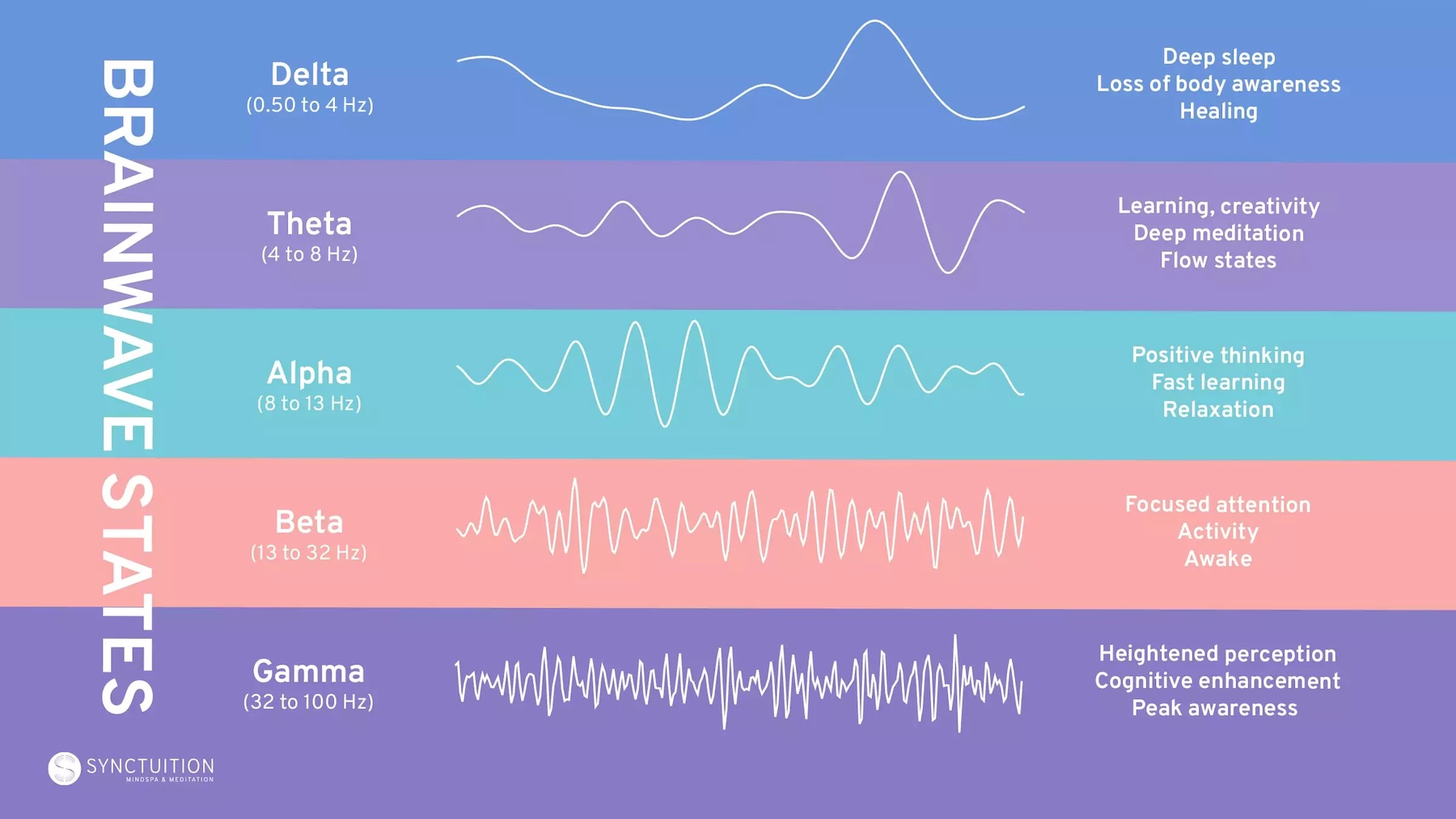
Delta (0.50 to 4 Hz)
Slow and loud, delta brainwaves are generated during dreamless sleep and relaxation. This state promotes healing and regeneration. This is why deep, restorative sleep is such an integral part of the healing process.
Theta (4 to 8 Hz)
Theta brainwaves are highly noticeable during REM sleep when we have vivid dreams. Research shows a positive relationship with learning, creativity, and intuition. In theta, our senses withdraw from the external world and focus on signals from within, which can help us achieve the well-known state of “flow.” Theta brainwaves are also present during deep meditation.
Alpha (8 to 13 Hz)
First discovered, alpha brainwaves are faster and more dominant during quiet thoughts. They can also be present in some meditation states. Overall, alpha brainwaves contribute to relaxation, positive thinking, and quick learning.
Beta (13 to 32 Hz)
Beta brainwaves dominate our normal state of consciousness. They are present when we are attentive, alert, and engaged in decision-making or mental activity.
Gamma (32 to 100 Hz)
The fastest of all, gamma brainwaves promote increased perception, learning, and problem-solving. Interestingly, gamma brainwaves are stronger and more regular in people who have been meditating for a long time.
Binaural beats are auditory illusions –
It’s ‘beats’ that occur when two different sound wave frequencies with a slight variation are played in each ear. This technique takes advantage of the fact that our brains tend to combine sound frequencies when they are heard simultaneously, resulting in an audible tone that is equal to the difference between the two original frequencies.
- Two tones: Imagine wearing headphones. In one ear, you hear a sound with a specific frequency, for example, 300 hertz (Hz), and in the other ear, you hear a sound with a slightly different frequency, say, 310 Hz. These two tones are delivered separately to each ear.
- Binaural beat: Because your brain tends to combine the two sound frequencies, you will hear a third sound that has a constant frequency of 10 Hz. This is called the binaural beat.
- Auditory system: This binaural beat is an artifact perceived only in your brain and is not actually produced in the external world. It is the result of the difference between the frequencies reaching each ear and the way your auditory system processes this information.
The Effect of Binaural Beats
Binaural beats are often used for various purposes, such as relaxation, meditation, focus, and sleep improvement. Some people claim that listening to binaural beats can help reduce stress, enhance concentration, or induce certain states of consciousness, such as lucid dreaming or meditative states.
Here are some potential health-related effects of binaural beats:
Relaxation and Stress Reduction: Some people report that listening to binaural beats helps them relax and reduce stress. The theory is that binaural beats can assist in synchronizing brainwaves into relaxing patterns, leading to a calming effect.
Improved Concentration and Focus: There are claims that binaural beats can help enhance concentration and focus. This can be useful for tasks such as studying or meditation.
Sleep Improvement: Some people use binaural beats to promote sleep or treat sleep disorders. The soothing effects of binaural beats can help with falling asleep and reaching deeper sleep stages.
Pain Relief: There are some suggestions that binaural beats may promote pain relief by stimulating the release of endorphins and reducing the perception of pain.
Mood and Emotion: Binaural beats are sometimes used to improve mood or promote emotional stability. This is based on the idea that they can influence brainwaves and, in turn, impact emotions.
The effect of binaural beats on individuals can vary, and scientific evidence for their effectiveness is mixed. While some people may benefit from using binaural beats, it’s important to remember that they may not work for everyone, and the effect can greatly depend on personal perception and sensitivity to such auditory stimuli.
Nevertheless, it is definitely worth trying binaural beats and observing their impact on you!
October, 2023


0 Comments